

 |
| I am told that this town's namesake in France is "home to the annual Erckmann-Chatrian summer festival." So there's that. |
Phalsberg
FranceERE Informatique (developer and publisher)
Released 1986 for Commodore 64 and DOS
Date Started: 29 January 2022I've often joked that French RPGs of the 1980s feel like they were designed by aliens who tried to replicate American RPGs from pictures they saw through telescopes. I've meant it when I've said it, while playing Le Maître des Âmes or Mandragore or the games of Herve Lange, but now I see I should have saved the comparison for a game that really deserved it. Phalsberg, as the kids say today, has entered the chat.
As often happens with French games, the lineage of Phalsberg is nigh-inscrutable. You might be fooled by the top-down, iconographic interface to think of Ultima, but so little actually happens on this screen that you feel more like you're seeing an automap than a game world. Most of the action occurs in the message window at the bottom, including combat, dialogue, and enemy and NPC comings and goings, and here the game plays a lot more like a text adventure--albeit one that, for some mysteriously infuriating reason, the developers decided should be playable with a joystick. You thus spent most of the game using the stick directions and fire button to navigate an utterly baffling list of commands, only a few of which are on the main screen. Now add completely nonsensical responses--or, worse, no responses--to most of your commands, and you know a little of what it's like to play.
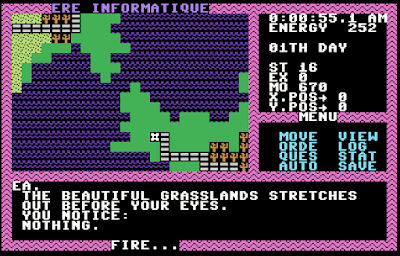 |
| The game begins northwest of the title town. |
The game is ERE Informatique's only attempt at an RPG, designed by a Michel Valentin (now MIA), and translated by the developer for release in the United Kingdom. I believe the original (official) English translation is lost, and what I'm playing is a modern translation, as some of the translation issues reported contemporaneously by Zzap!64 are not here and others are. Also, the pre-title "warez" screens take credit for translation. I've yet to find a manual, but some text screens relate that it takes place in the world of Kalvor, where good King Philoxal has been deposed by Blackstar, commander of the Pretorien Guards. Blackstar has hidden Philoxal and scattered his kingly artifacts--crown, scarab, and scepter--to the four corners of the world. The player must find them and reunite them with the exiled Philoxal. Phalsberg is a town near the beginning. I can't say for sure that it's the source of the game name, but "Phalsbourg" is a town in northeastern France.
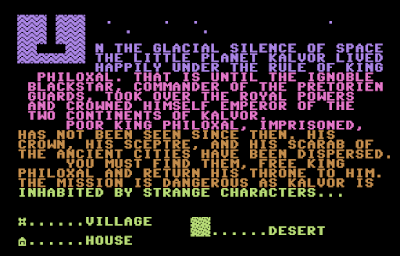 |
| "Philoxal" sounds like a drug designed to keep you awake during ethics classes. |
Character creation prepares the player for the rest of the game in its needless complexity. It took me about six tries before I fully understood what was happening (with help from Abacos's StrategyWiki article). During the process, you roll values for constitution, life points, defense, reflexes, intelligence, beauty, money, and experience points. "Energy points" are a product of constitution and life points, and "charisma" is a sum of intelligence and beauty. Each attribute has a different maximum for the dice, from 5 (beauty) to 15 (constitution and life points); the maximum for money is 1,000. But each attribute also gets a bonus or penalty from 5 to -2 depending on the order that you roll. Whatever attribute you roll first gets a bonus of 5, the next a bonus of 4, the net a bonus of 3, and so forth. The sixth attribute gets no bonus, and the last two get penalties of -1 and -2. As if that isn't complicated enough, you then immediately can spend whatever you rolled for experience on additional points.
 |
| I got lucky with some of these rolls, but I'm not sure I care for the character portrait. |
After giving yourself a name (you cannot capitalize your first letter), you choose from human, dwarf, and elf races. Humans can then choose from warrior, thief, cleric, and magician classes, but elves and dwarves have no such choices. The idea that "elf" and "dwarf" are both races and classes goes, I think, back to the original edition of D&D and is often found in mid-1980s French RPGs like Fer & Flamme, Le Maître des Âmes (1987) and L'Anneau de Zingara (1987). I'm not sure when French players would have received a translation of Advanced Dungeons & Dragons and the more complex race/class rules.
Gameplay starts on a tiled overworld near Phalsberg. Other than landscape features, the world is dotted with visitable locations like towns, temples, and cemeteries. These locations don't allow you to enter and explore, but each has a unique graphic, accessed by the "View" command on the main screen, some of which offer some runic writing that may be intended as clues. Some commands only work in particular locations, and the player is more likely to encounter NPCs in towns and enemies in other locations.
 |
| The view of a cemetery. |
As for the commands, there are a baffling number, made all the more difficult by the fact that the game only lists the first four letters. ATTA is not "Attack," like you might expect, but "Attach." Most of the others are decipherable, but until I find the right circumstance in which I might want to BEWI or THRE someone, I won't know for sure. DIP is a bit of a mystery, as is MATE (the game just tells me I'm not a high enough level). There are 46 commands in all. But it gets worse. If you choose a lot of them, like ENTE(r), BUY, HUNT, TAKE, SELL, SEAR(ch), and EAT, the game brings up a sub-menu in which you have to specify FOOD, DECO(ration?), PLAC(e), OBJE(ct), or CHAR(acter), and then a sub-sub menu of the game's different choices, including 37 different objects and 38 different characters. Thus, when you're finished with combat and want to loot the enemy, you can't just execute a generic SEARCH, or TAKE from a selection of objects actually present. You have to remember exactly what the enemy was carrying and specify that you want to take that particular thing. Is there any situation in which I'm going to be able to BUY a vampire, HUNT a door, or TAKE a tavern? And why isn't KILL--the only combat command--not on the main screen given how often you use it? Even better, why aren't all these commands mapped to keys instead of requiring me to move around with the goddamned joystick?
 |
| The many objects that I can TAKE, BUY, SELL, or, apparently, EAT. |
As you move around, the game periodically stops you for an encounter. Like moving the joystick around, it takes a maddeningly long time. There's a pause as you realize you can no longer move and the game is accessing the disk. Then it loads the encounter line by line with a lot of disk access between lines. I have it at 200%, which is about as high as I can go before it starts over-reading my inputs, and it's still too slow.
Enemies always "rise up" in front of you. The game gives you their energy points and objects carried. Sometimes, they attack right away. If you want to fight them, you choose ORDE(r) and then KILL, though if you switch to VIEW in combat, you'll get a cheesy graphic of the enemy. Most combats, at least in the early game, are over in a single round. I have not yet figured out how to loot dead enemies; TAKE and GOLD doesn't seem to work despite most of them having "purses." You get experience from encounters--and also, oddly, from successfully sleeping. I think there's supposed to be a way to convert that experience to attributes, but I can't find the right command.
 |
| "It's a SHOULDER BAG," the goblin protests. |
Locations also have other things, such as objects and occasionally NPCs. With NPCs, the most important thing you can do is QUES(tion), which brings up a list of 25 potential questions, most dealing with things and people that the early-game character hasn't learned about yet, such as WHERE IS AMYRTHE?, WHO HAS THE KEY?, WHERE IS THE WHITE DRAGON?, and TO WHO SHOULD I GIVE THE RING? NPCs answer or don't answer based, I guess, on your charisma. I have a few hints like:
- Go to the Sanctuary of Tallin with your cross.
- To find the crown, you have to find the Sword of Airain.
- With the map, you will go in search of the Lens of the Astrolabe.
- The Amazons hold the Key of the Tomb.
 |
| I'll do you one better: WHY is Amyrthe? |
So I gather that the key to this game is visiting all the locations and finding various objects in the right sequence and maybe solving some light puzzles that will require commands like DIG, CLIM(b), STEA(l) (or "Stealth"?), PICK, SWIM, and whatever REPL is ("Replace"? "Replicate"?). You know, I really do enjoy being the first person to explore some of these games in detail, but this latest set of games is starting to wear down that resolve. Wasn't Danse Macabre, Towers, and WarWizard enough?
A few other notes:
- There's a clock on the main screen that inexplicably tracks time in real time, even while moving, although it automatically advances a few hours when sleeping.
- "Energy" serves as both a health and stamina reservoir. It decreases as you move--based partly on encumbrance, I think. A little tone plays with each move, and the tone gets lower as your energy decreases.
- Although ostensibly set in a medieval world, there are some modern or even sci-fi elements. One of the commands is PHOT(ograph), for instance, and one of the questions is WHAT SHOULD I PHOTOGRAPH? One of the objects is LASE(r).
- If you step into water, you automatically die.
- The one thing I can praise the game for is offering a coordinate system. You start the game at 0,0, northwest of Phalsberg, and increment by 1 for every move east or south. I can get to 25, 14 without needing a boat, but it's clear that to fully explore the world, I'm going to need to move between islands.
- I haven't yet figured out what the AUTO command does except automatically show you the current VIEW every time you stop moving or come to a special location.
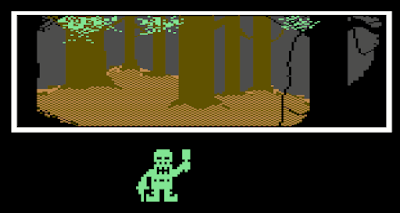 |
| Switching to VIEW with an enemy on the screen. |
Getting back to the question of lineage, Phalsberg actually plays a lot like Tera: La Cité des Crânes from the same year (link to my coverage). The games look nothing alike, but they both have a fantasy/sci-fi blend; they both have a large number of adventure game-style commands (though in Tera's case, called sensibly from the keyboard); and they both depend heavily on special locations with evocative names. Phalsberg's "views" even remind me a bit of Tera's screens, and the hints you get from NPCs seem similar. I wonder whether this is all a coincidence, whether Michel Valentin was either "Ulysses" or "Lout" (the creators of Tera), or whether both games have a third common ancestor.
I toyed with calling the game "unplayable without the manual" and making this a BRIEF, but I know from experience that it will only take a few minutes for a manual to show up if I do that. So I'll settle for just keeping this entry very short. I'll start visiting the locations and methodically trying the various commands and taking more detailed NPC notes. We'll see what develops.
Time so far: 2 hours

![[Tested] 8ball.Gameapp.Pro 8 Ball Pool Guideline Hack Cheat Engine 2020 Legits 99,999 Cash and Coins](https://lh3.googleusercontent.com/blogger_img_proxy/AEn0k_sEZHLuzXAE7rvM1LyzbHJOTxIETTYlN9K19onNgNSMLu1zD8GG03NX4xONy1iKDL4hbiljUFAUzjveNm95FCWVzhWfuF3hO-1YUNLHnnitAujvi-TjnQo=w100)





0 Comments